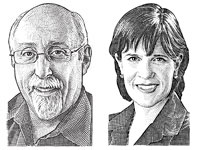
Walt Mossberg and Kara Swisher

Recent Columns by Walt Mossberg

Welcome to Web 3.0

walt-kara

At All Things Digital World Headquarters*, our huge staff of expert analysts** is always keeping track of two things: The latest trends in tech and media, and the latest jargon used to hype those trends.

This year, as we convene the seventh edition of D: All Things Digital, we think something major is happening at the intersection of tech and media, and we think it deserves its own new hyped-up name: Web 3.0. Yes, folks, we are declaring the Web 2.0 era over, because, well, when you run conferences and Web sites, you can say stuff like that.

But, if you read on a bit, you will see that we actually have some real, rational basis for believing that yet another seminal moment has arrived in the never-ending digital revolution that inspired us to launch this gathering. And, as you will observe over the next few days, we have assembled what we think is a stellar lineup of speakers to address this major change and other topics.

First, though, a few words about the elephant in the ballroom: The Great Recession. Or, as we like to call it on the AllThingsD.com Web site: The Econalypse. We started work on launching D during the last tech bust, and we believed then that — despite the very real economic woes afflicting the industry–the digital tidal wave sweeping the world wasn’t stopping. In fact, it was during that last recession that the iPod, iTunes, Windows XP, Mac OS X and early social networking services, like Friendster and LinkedIn, were born.

We are painfully aware that this crisis is far worse–we work at a media company, after all, and media companies have been economic piñatas lately. We do not in any way underestimate the economic pain and danger still under way all over the world. But we still believe the digital tidal wave rolls on. And we are immensely grateful to all of you for continuing to attend D under these tough circumstances. In fact, your support has been so strong that we actually sold out a few days earlier this year than last.

So what’s the seminal development that’s ushering in the era of Web 3.0? It’s the real arrival, after years of false predictions, of the thin client, running clean, simple software, against cloud-based data and services. The poster children for this new era have been the Apple iPhone and iPod Touch, which have sold 37 million units in less than two years and attracted 35,000 apps and one billion app downloads in just nine months.

The excitement and energy around the iPhone and the Touch–and the software and services being written for them–remind us of the formative years of the PC and PC software, in the early 1980s, or the early days of the Web in the mid-1990s.

It’s a big deal.

But this is not just about one company, one platform or even one form factor. No, this new phenomenon is about handheld computers from many companies, with software platforms and distribution mechanisms tightly tied to cloud-based services, whether they are multi-player games, e-commerce offerings or corporate databases.

Already Palm, Research in Motion, Nokia, Microsoft and others are hot on Apple’s tail. You will hear from them here at D. And a profusion of new devices, software development kits, app stores and cloud-based services has been announced in the teeth of the economic downturn.

Some of these handheld computers will make phone calls, but others won’t. Some will fit in a pocket, but others will be tablets or even laptop-type clamshells. But, like the iPhone, all will be fusions of clever new hardware, innovative client software and powerful server-based components.

And media companies are on the case, too. You can already read The Wall Street Journal and other news sources, complete with photos and videos, on the iPhone, the BlackBerry and the Kindle, and new handheld devices are coming that are tailored to news. Our own AllThingsD iPhone app will be out by the time you read this. And consumers can stream radio and TV, and even follow live sports events, on pocket devices.

Over the next few days, you’ll hear from Microsoft CEO Steve Ballmer, whose company makes software for both the new platforms and the traditional PCs they threaten. And the leaders of the hottest social network, Twitter, Evan Williams and Biz Stone, will talk about its future. Speaking of the future of social networking, we have invited News Corp. digital head Jon Miller and MySpace CEO Owen Van Natta, who were recently brought in to reinvigorate the media giant’s business, to talk about how they plan to do just that.

You’ll hear from new Yahoo CEO Carol Bartz, who’s trying to deal with rivals and suitors just as the new era is dawning. Also on stage will be the leaders of some key companies making the handheld computers’ hardware and software: Mike Lazaridis of RIM; Jon Rubinstein and Roger McNamee of Palm; and Olli-Pekka Kallasvuo of the worldwide mobile phone leader, Nokia.

From the telecom side, there’ll be Randall Stephenson of AT&T. Cable pioneer and media mogul John Malone will offer his perspective on the future of television.

And, from the content world, we’ll have Jeff Zucker of NBC, Irving Azoff of Ticketmaster, Mark Cuban of HDNet, blogging queen Arianna Huffington and Washington Post publisher Katharine Weymouth.

The leaders of Mozilla, Mitchell Baker and John Lilly, will talk about the role of Web browsers and open source. And playwright Eve Ensler will explain how all this shiny technology is tied, unwittingly, to a crisis thousands of miles away.

So sit back, open your minds, and get ready for Web 3.0.

*Actually, just a cottage in back of Kara’s house.

**Actually, just a handful of journalists, a couple of editors, a geek and an intern, plus some business people.


comments so far. Add yours.

  • http://radar.oreilly.com Tim O’Reilly

    There’s no question that what’s happening in the marketplace is as significant a step forward as Web 2.0, but calling it Web 3.0 seems a bit silly. After all, Web 2.0 was not a new version of the web, but a name that tried to capture what distinguished the companies that survived the dotcom bust from those that survived, and point the way forward for new companies entering the market.

    In that sense, what you’re talking about is really phone 2.0: how the iPhone changed all the rules of the phone market, and the new rules that guide that market going forward.

    There’s a lot of fascinating new stuff happening on the web right now too, including stuff on mobile, but I’m not calling that phone 2.0 :-)

    Have fun at D. Sorry I couldn’t make it this year – there’s some really cool stuff being introduced at Google I/O, and I got roped into being part of the announcements there.

  • http://armandbrahaj.blog.al/ Armand Brahaj

    There should be some technical explanations behind a “Web 3.0″ concept and not just a “Rush for Gold” trend.

    What you explain as Web 3.0 is just a “big players” approach to new trade options. Nothing to do with the web, the users or concepts of internet.

  • http://www.terryhoward.net Terry Howard

    The only thing “thin” about iPhones, iPod Touches, the Kindle and Netbooks is their form factor. They are still nothing near cloud computing. Further, cloud computer will remain a fantasy as long as we still have issues such as throttled and saturated bandwidth, whether by the spammers or providers themselves. Sometimes it can get a little difficult to just get a file down the pipe in a speedy manner, can you imagine what it would be like to move your processing off your dedicated chip? Personally, with chip and memory costs quickly shrinking, what really is the benefit and gain of cloud computing anymore really?

  • http://www.avanade.com Brian Duperrouzel

    Agree with Tim, that this sounds more like Phone 2.0 than Web 3.0.

    Maybe Web 3.0 can raise the bar on targeting ‘real’ global problems. I think we are all getting sick of reading about how Ashton Kutcher keeps his fans updated ….

  • Bjorn Tipling

    Did you really have to go there and call it “Web 3.0″ ?

  • http://www.erikyuzwa.com erik yuzwa

    Kind of ironic that the Web3.0 arrival is declared on a Web1.5 delivery system..no? :)

  • http://factoryjoe.com Chris Messina

    And they say that old media has a credibility problem. Ha! Seems more like a terminal fascination with empty hypememes.

  • http://judy.shapiro@verizon.net Judy Shapiro

    The name Web 3.0 seems like an ill fitting suited because it evokes a software release, obscuring the vision for the next gen web as being about creating a human, personal web for each of us.

    At last week’s Web 3.0 Conference, I was struck by the advances in technologies on all fronts. Yet nowhere could I find anyone talking much about how to make the next web more human by making it more trusted.

    Why do I think trust is the key “human element” that should drive how the next gen web is built?

    Simple.

    Trust is the glue that holds society together in the real world and it should be the same in the web world too. One can not have technological innovation without being able to trust, no matter how linked our data becomes or how intelligent the web gets.

    Let’s put energy into creating innovation around how to apply trust to the web world with new technologies around search, authentication, advertising, security, privacy and ID management (and OpenID ain’t the answer folks).

    That’s why “renaming” Web 3.0 to the Trusted Web makes sense. With a name change, it may change the field of vision to the human element of trust, so the technology wizards can weave their magic within that context.

    This is where vision is required.

    Judy Shapiro

    SVP, Paltalk

    Ad Age’s DigitalNext posted a recent article on this entitled; “Postcards from the Bleeding Edge”

  • http://amul.mago@yahoo.com Amul Mago

    Not sure using Web 3.0 as the tag line was to grab attention or was there anything like that. To me it appears more like defining the agenda for the conference and there is nothing 3.0 about it.

    Cannot agree much with Tim; there might be new applications for mobile devices that enable access to web 2.0 (which to me is information flow to & fro).

    Believe what you are trying to communicate is these new set of applications/ devices/ service will enable users (to contribute & express) towards an easy and rich experience.

    Though thanks for grabbing my attention:)

  • http://vista-interactive.com Peter Murray

    Seth Godin is great at definitions. He blogged a couple of years ago about Web 2.0, Web 3.0 and Web4 at http://sethgodin.typepad.com/s...../web4.html.

  • Counsel Dew

    Web 3.0 is not an accurate description, but it did get you page hits…

    Sad day when we need to “create” hype to get hits rather than just report on news… I hope you have better standards moving forward than the major news media companies…

    (Page isn’t displaying well on Firefox–form isn’t “lined up well”)

  • http://www.koolaidantidote.com Tom Kasperski

    Have we reached the crescendo of the sillynamealypse yet?

  • http://www.realitytest.com Bill Ingle

    1. Who is to say whether all but a few newspaper entities — including one or two quality papers and a number of tiny, local, and “free” (advertising supported) papers — will survive a continuing structural meltdown?

    You may end up with ad hoc collections of professionals paid directly by readers — using the web, of course — either in advance or after-the-fact.

    The “digital revolution” is of course a major factor in the meltdown, but it can also be seen as an external symbol for something else, something off all present official radar screens.

    2. How can an event called “All Things Digital” exclude machine-to-machine (M2M)? (See http://www.beechamresearch.com .)

    3. The statement “…comment is free but facts are sacred” appeared in a 1921 essay on journalism. This site:

    http://www.guardian.co.uk/commentisfree followed, many years later.

    Here anyone is free to contribute up to 5,000 characters per comment on a vast assortment of constantly changing topics.

    (Of course the author of the 1921 essay never imagined such a reality.)

    PS. The layout of the legends in relation to the three entry fields is mildly confusing.

  • http://thebankwatch.com Colin Henderson

    If you insist on going down this road, 2.5 is the most you get. 3.0 has to be a sea shift – secure identities shared across the 2.0 landscape for example.

  • http://www.tigtags.com Stan Wiechers

    There is a general misunderstanding of the importance of iPhone apps. Apps are useful no doubt, but the hype lets us overlook the fact that the most used app on a iPhone is the web browser (besides sms/mail). Same as on the desktop. And the best way to find information that leads to websites is google. Same as on the desktop. This matters most not 3rd party apps. Its the mobile web.

  • http://carlton-northern.com Carlton Northern

    You guys are just dead wrong. How can you call mobile computing web 3.0? There completely separate topics.

    Web 3.0 is, unlike its predecessors (a web of linked documents), a web of linked data. A web where the conceptual and semantic understanding of its content is just as important as its presentation. This idea is still in its infancy, but shouldnt Web 3.0 be something that is new, rather than something that we’ve been doing for the past few years?

Real Bonding With Family Around the TV Via Skype

January 25, 2012 at 6:03 pm PT

Track Changes on an iPad

January 25, 2012 at 6:02 pm PT

Talk Is Cheap and Reliable on Nokia’s $50 Phone

January 18, 2012 at 6:03 pm PT

Working in Word, Excel, PowerPoint on an iPad

January 11, 2012 at 6:04 pm PT

D7 Conference

Conversations with the most influential figures in media and technology.
May 25-27, 2009
Carlsbad, California

Dive Into Media

Latest Video

View all videos »

Search »

D Conference Mailing List

Sign up for News about D Conferences